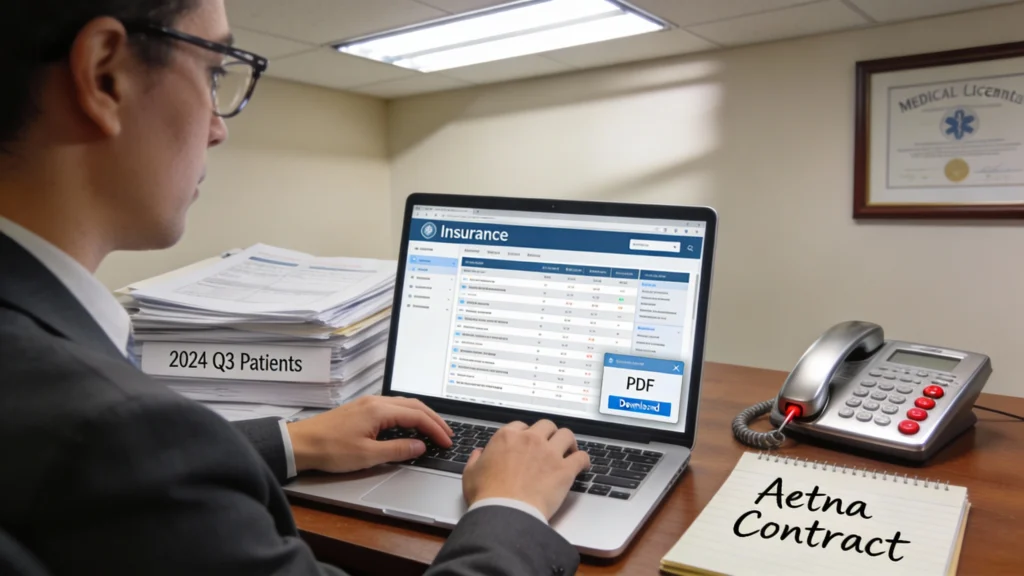


Understanding the Aetna Physical Therapy Fee Schedule for Your Clinic

Every 15-minute unit you bill to Aetna can mean a profit or a loss, depending on how well you understand the numbers behind it. For outpatient physical therapy clinics, a few dollars difference per CPT code quickly compounds into thousands of dollars annually across hundreds of visits.

The Aetna physical therapy fee schedule is the backbone of your reimbursement, dictating exactly what Aetna will allow for each billed unit. When owners and billers understand how these allowed amounts connect to physical therapy CPT codes, they can forecast revenue, detect underpayments, and correct coding issues before they drain margins.

Because each Aetna contract is specific to your tax ID, location, and product lines, relying on generic payment assumptions is risky. A disciplined, data-driven review of your Aetna physical therapy fee schedule helps you align visit templates, therapist productivity expectations, and cash flow projections with real contracted rates instead of rough estimates.

By systematically linking documentation, coding, and billing workflows back to your actual fee schedule, you ensure that every legitimately provided service is billed accurately and paid at the contracted amount. Over a full year, even a $5 improvement in average reimbursement per visit can add $25,000 or more in revenue for a modest clinic seeing 100 visits weekly.

1
aetna physical therapy fee schedule

What Is the Aetna Physical Therapy Fee Schedule and How Is It Structured?

What Is the Aetna Physical Therapy Fee Schedule and How Is It Structured?

The Aetna physical therapy fee schedule is typically organized by CPT code, allowed amount, and sometimes modifiers or units, giving you a clear view of how each service is valued. Studying this structure helps you understand which treatments drive the most revenue and how different visit patterns impact reimbursement at the code level.

The Aetna physical therapy fee schedule is a contract-specific list of CPT codes, modifiers, and corresponding allowed amounts that governs reimbursement for your clinic. It usually references a percentage of Medicare’s Physician Fee Schedule, such as 110% of the 2024 non-facility rate, then applies Aetna-specific adjustments by geographic region, product type, and provider specialty.

Core Components of the Aetna Fee Schedule

Most Aetna physical therapy fee schedules are delivered as Excel or PDF files with columns for CPT code, description, RVUs, and allowed amount. Some include separate lines for modifiers like GP or CQ, or for place-of-service differences. Understanding how time-based codes, like 97110, differ from service-based codes, like 97016, helps you structure visit durations and units to match contractual reimbursement mechanics.

How Allowed Amounts Tie to CPT Codes and Modifiers

Each physical therapy CPT code on your schedule has a specific allowed amount per unit, often rounded to the nearest cent. Modifiers such as GP, 59, or KX do not usually change the dollar value but determine whether Aetna will consider the code payable. In some contracts, CQ or CO modifiers trigger 15% reductions for assistant-provided services, which must be reflected in your revenue modeling.


2
aetna physical therapy

Finding and Interpreting Your Aetna Physical Therapy Fee Schedule

Locating your exact Aetna physical therapy fee schedule requires accessing payer portals or your original contract documents. Most clinics download their schedules from Availity or Aetna’s provider portal under the fee schedule or contract documents section. If your schedule is missing, a written request to your provider representative or contracting department typically yields an updated file within 10–15 business days.

Finding and Interpreting Your Aetna Physical Therapy Fee Schedule

Once your Aetna fee schedule is mapped to actual visit patterns, it becomes a powerful forecasting tool. By combining contracted rates with expected visit volumes and payer mix, you can project cash flow, set realistic productivity benchmarks, and evaluate whether staffing levels and scheduling templates support your financial goals for the clinic.

Where to Obtain the Correct Contracted Schedule

You should verify that the fee schedule you use matches your tax ID, NPI, and service location, because Aetna often differentiates rates by county or state. Compare the effective date on the schedule with your contract amendment letters, checking that product types such as HMO, PPO, and Medicare Advantage are clearly labeled. Maintaining separate folders by TIN and location prevents inadvertently applying outdated or incorrect rates when planning.

Reading Key Columns and Terms Accurately

When reviewing the spreadsheet, focus on columns for CPT code, modifier requirements, place of service, and allowed amount. Some schedules list multiple rates per code, such as office (POS 11) versus outpatient hospital (POS 22), which can differ by 10–20%. Highlight high-volume codes, like 97110 and 97140, then calculate their weighted average impact on a typical visit to understand true revenue per encounter.

3

Linking the Aetna Physical Therapy Fee Schedule to Common PT CPT Codes

Connecting your Aetna physical therapy fee schedule to real-world physical therapy CPT codes clarifies which services drive revenue and which barely cover costs. Because most PT visits cluster around 4–5 time-based units, small differences between codes, like 97110 versus 97530, change the financial profile of an entire plan of care. Mapping these rates helps you design visit templates that remain clinically sound yet financially sustainable.

Linking the Aetna Physical Therapy Fee Schedule to Common PT CPT Codes

Linking the Aetna fee schedule to your most-used CPT codes is essential for accurate visit planning. When therapists understand the relative value of evaluation, therapeutic exercise, manual therapy, and neuromuscular reeducation codes, they can build medically appropriate treatment plans that also support sustainable reimbursement and reduce the risk of unintentional underbilling.

Sample Aetna-Contracted Rates for Common PT Codes

The example below assumes a hypothetical Aetna commercial contract paying slightly above 2024 Medicare non-facility rates. Your actual numbers will differ, but the relationships between codes are similar. By comparing allowed amounts per 15-minute unit, you can see how shifting one unit from a low-value to higher-value code, when clinically appropriate, may add $5–$8 per visit.

CPT CodeDescriptionTypeAllowed per Unit (USD)Typical Units/Visit
97110Therapeutic exerciseTime-based38.502
97140Manual therapyTime-based40.251
97530Therapeutic activitiesTime-based42.751
97112Neuromuscular reeducationTime-based41.101
97016Vasopneumatic deviceService-based24.001
97161PT evaluation low complexityService-based92.001

Using this sample, a common follow-up visit with two units of 97110, one unit of 97140, and one unit of 97530 would allow $160.00. If documentation supports substituting one 97110 unit with 97530, allowed reimbursement increases by $4.25. Over 1,000 similar visits annually, that small shift yields $4,250 more revenue without changing visit length or clinical intensity.

4

Using the Aetna Physical Therapy Fee Schedule for Financial Forecasting

Once you understand how physical therapy CPT codes map to Aetna’s allowed amounts, you can build reliable revenue forecasts. Start by defining typical visit profiles, such as new evaluations with three follow-up units or complex neuro visits with six units. Assign probabilities based on historical data, then multiply each profile’s total allowed amount by projected visit volume to estimate monthly and annual revenue per therapist.

Using the Aetna Physical Therapy Fee Schedule for Financial Forecasting

Finding your actual Aetna fee schedule often requires logging into payer portals, pulling contract documents, or requesting updated rate sheets from your representative. Once obtained, comparing these contracted amounts to your practice management reports allows you to spot discrepancies, underpayments, or outdated assumptions that may be quietly eroding your margins.

Building Revenue Models from Visit Mix

Forecasting begins by segmenting visits into 3–5 categories, for example: standard orthopedic follow-up, post-operative rehab, chronic pain management, and neurologic rehab. For each category, calculate average units per code and associated Aetna allowed totals. Combining these with realistic weekly visit counts, such as 90 visits per full-time therapist, allows you to project cash inflows and determine sustainable salaries, rent, and equipment budgets.

Clinics that update payer-specific revenue models quarterly, using real claim data and current fee schedules, often identify 5–10% swings in payer mix or allowed amounts before they significantly impact cash flow, enabling proactive staffing and marketing adjustments instead of reactive cost-cutting.

Translating Allowed Amounts into Productivity Targets

After modeling average Aetna revenue per visit, you can convert those figures into daily productivity expectations. For instance, if an Aetna-heavy therapist averages $135 per visit and is scheduled for 12 visits daily, gross daily revenue targets should hover around $1,620. Monitoring actual reimbursement against these benchmarks quickly reveals documentation gaps, coding errors, or scheduling inefficiencies undermining your contractual potential.

5

Auditing Claims Against the Aetna Physical Therapy Fee Schedule

Comparing Aetna explanations of benefits to your contracted fee schedule is the most direct way to uncover underpayments. By exporting 30–60 days of claims data, then matching each CPT code and allowed amount to your schedule, you can quickly spot patterns where Aetna consistently pays $2–$4 less per unit than contracted. Even minor discrepancies across hundreds of visits can add up to thousands of dollars in missed revenue.

Auditing Claims Against the Aetna Physical Therapy Fee Schedule

Systematic Claim Review Workflow

Effective auditing starts with pulling remittance files in Excel or CSV format, then sorting by CPT code and payer. Create formulas that compare the paid allowed amount to your fee schedule, flagging differences greater than $0.01. Review a random sample of flagged claims to rule out coordination of benefits or deductible impacts, then escalate true underpayments through Aetna’s provider dispute process within the specified appeal window.

  • Export 60–90 days of Aetna remittances, including CPT codes, units, allowed amounts, and patient responsibility columns.
  • Join remittance data to your Aetna physical therapy fee schedule using VLOOKUP or INDEX-MATCH formulas in Excel.
  • Highlight rows where Aetna’s allowed amount differs from the contracted rate by more than one cent per unit.
  • Investigate whether differences stem from modifiers, place-of-service changes, or incorrect plan mapping before appealing.
  • Submit batched appeals with side-by-side comparisons, requesting retroactive adjustments for all affected claim lines.
6

Negotiation Basics Using Your Aetna Physical Therapy Fee Schedule Data

Negotiation Basics Using Your Aetna Physical Therapy Fee Schedule Data

Armed with clear data from your Aetna physical therapy fee schedule and claims history, you can approach contract negotiations with specific, evidence-based requests. Rather than asking for a generic rate increase, compare your Aetna allowed amounts to Medicare and other commercial payers for the same CPT codes. Highlight codes where Aetna pays significantly below market, especially for high-volume services driving most of your visit revenue.

When and How to Request a Rate Review

Most clinics initiate rate reviews every two to three years or when they notice Aetna falling more than 10–15% below comparable payers. Begin by summarizing annual Aetna visit volume, total payments, and average reimbursement per visit. Present this alongside regional benchmarks, such as Medicare plus 20%, then request targeted increases on specific codes like 97110, 97140, and 97530, which collectively represent over 60% of many clinics’ units.

Negotiations are more successful when you show Aetna that your clinic drives measurable value, such as reduced imaging or surgery rates, while also demonstrating that current contracted rates sit materially below both Medicare benchmarks and competing commercial contracts for the same services.

Structuring Negotiation Proposals Around CPT Data

Instead of asking for a blanket 10% increase, propose tiered adjustments concentrated on your top 10 physical therapy CPT codes. For example, request a 15% increase on 97110 and 97530, a 10% increase on 97140 and 97112, and a modest 5% increase on evaluation codes. Showing how these changes impact your average reimbursement per visit clarifies that you seek sustainable, not excessive, improvements.

7

Aligning Documentation and Coding With the Aetna Physical Therapy Fee Schedule

Your ability to realize the full value of the Aetna physical therapy fee schedule depends entirely on accurate documentation, coding, and modifier usage. Each billed unit must reflect at least 15 minutes of skilled, one-on-one care for time-based codes, following the eight-minute rule. If therapists routinely under-document or default to low-value codes, your clinic leaves contracted dollars unclaimed, even when services were legitimately provided.

Aligning Documentation and Coding With the Aetna Physical Therapy Fee Schedule

Ensuring Units and Modifiers Match Delivered Care

Aligning documentation with billing starts by training therapists to document start and stop times, skilled interventions, and patient responses for every unit. Codes like 97110 and 97530 should be chosen based on the primary therapeutic intent, not habit. Modifiers such as GP must appear on all PT codes, and CQ should be appended whenever assistants provide more than 10% of a timed service, preventing denials and recoupments.

  • Educate clinicians on time-based versus service-based codes using real Aetna reimbursement examples and visit scenarios.
  • Implement EMR templates that prompt therapists to select primary and secondary codes aligned with documented goals.
  • Run monthly audits comparing documented minutes to billed units, flagging underbilling or inconsistent code selection.
  • Require GP, CQ, and 59 modifiers where appropriate, with billing software edits preventing claims from leaving incomplete.
  • Provide individual feedback to therapists, showing how precise coding changes average revenue per visit over 90 days.
8

Monitoring Changes to the Aetna Physical Therapy Fee Schedule Over Time

Monitoring Changes to the Aetna Physical Therapy Fee Schedule Over Time

Aetna periodically updates fee schedules in response to Medicare changes, regulatory shifts, or internal repricing strategies. These updates may occur annually or mid-year and can move allowed amounts by 3–8% for key codes. If your clinic does not actively track these revisions, you may continue forecasting and setting therapist targets based on outdated rates, leading to unexpected shortfalls or unrecognized upside.

Tracking Updates and Adjusting Strategy

To stay current, assign one team member to download new Aetna fee schedules quarterly and compare them to the prior version. Use spreadsheet formulas to calculate percentage changes for each physical therapy CPT code, highlighting shifts greater than 5%. Share concise summaries with leadership and therapists, translating code-level changes into expected differences in average revenue per visit and per full-time equivalent.

Clinics that maintain a simple dashboard tracking payer-specific rate changes, payer mix, and average reimbursement per visit can quickly recalibrate scheduling templates and staffing decisions, protecting margins even when external pricing pressures intensify.

Communicating Changes Internally and Updating Tools

Whenever Aetna updates rates, refresh your forecasting models, therapist productivity benchmarks, and any patient-facing financial estimates. Update EMR fee schedules so front-desk teams collect accurate copay and coinsurance estimates based on current allowed amounts. Regularly reviewing these changes in staff meetings reinforces the connection between meticulous documentation, correct coding, and the clinic’s ability to invest in equipment, continuing education, and competitive compensation.

Face, Neck, Head, Body, Back & Foot Massager
For a Relaxing & Relieving Lifestyle
14-day money back guarantee
Lowest Prices: 365 Days Discount
Safe & Secure online payment
Contact Us

Massagers Mart © 2025. All Rights Reserved

Massagers Mart
Logo
Compare items
  • Total (0)
Compare
0
Shopping cart