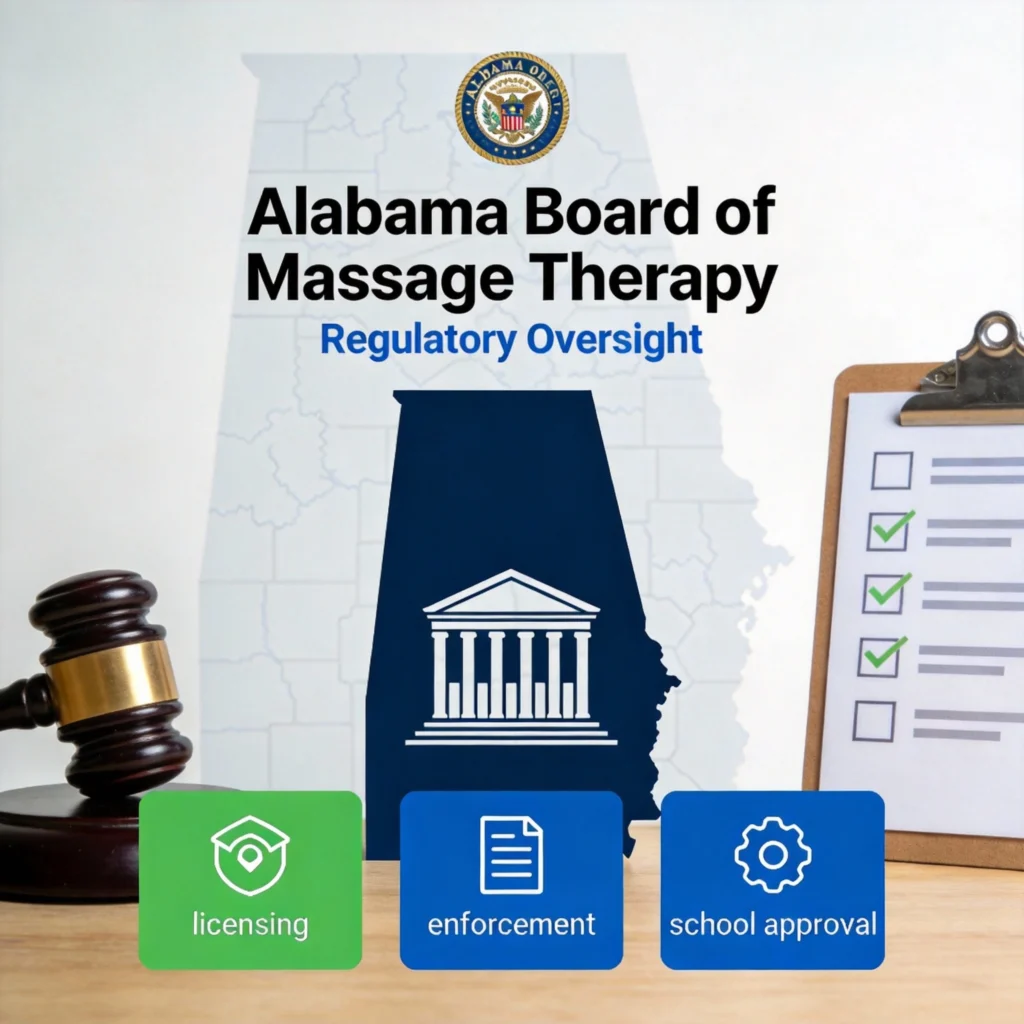
Before you schedule a single paying client in Alabama, you must understand how massage therapy is regulated statewide. The Alabama Board of Massage Therapy controls who can practice, how licenses are issued, and what happens when rules are broken, so learning their requirements early prevents costly delays or disciplinary problems later.

The Alabama Board of Massage Therapy is the state agency that licenses massage therapists, approves schools, and enforces practice standards. Anyone performing massage for compensation in Alabama generally needs an active license issued by this board, not just a local business permit. Knowing how the Alabama massage therapy board operates helps you plan your education, exams, and application timeline realistically.

Because the board works under Alabama statutes and administrative rules, its decisions carry legal weight. Application denials, complaints, or missed renewals can affect your ability to work in any healthcare setting, from spas to hospitals. Understanding their processes for background checks, continuing education, and discipline lets you avoid preventable mistakes and keep your record clean over the long term.

Licensing isn’t a one-time task, either. The board sets renewal cycles, continuing education hour minimums, and documentation standards that repeat every few years. If you track these requirements from the beginning, you can budget for fees, select CE courses strategically, and respond quickly when the Alabama Board of Massage Therapy updates its rules or online systems.

1
Alabama Board of Massage Therapy

What the Alabama Board of Massage Therapy Does and Why It Matters

What the Alabama Board of Massage Therapy Does and Why It Matters

The Alabama Board of Massage Therapy does far more than just print licenses. It approves schools, defines practice standards, and investigates complaints when rules are broken. By understanding the board’s authority and responsibilities, you can better anticipate what documentation, training, and conduct will be required to maintain your license in good standing.

The Alabama Board of Massage Therapy is a regulatory agency created by state law to oversee massage practice. It issues licenses, registers massage establishments, and approves schools that meet specific curriculum criteria. By centralizing oversight in one body, Alabama can track every licensee, monitor complaints statewide, and keep an official database employers and clients can verify before hiring or booking services.

Regulatory Authority and Public Protection

The board’s authority comes from Alabama statutes, typically found in the state code covering professional licensing. Those statutes authorize the board to adopt rules, collect fees, and investigate misconduct. They can subpoena records, hold hearings, and impose fines or suspensions. This enforcement power protects the public from untrained practitioners, fraudulent credentials, or unethical conduct, while also protecting ethical therapists from unfair competition.

Setting Professional Standards and Scope

Beyond licensing, the Alabama massage therapy board defines what counts as massage therapy, which techniques fall under its jurisdiction, and which titles licensees may use. It also sets minimum education hours, exam standards, and continuing education content areas. By standardizing these requirements, the board ensures that a therapist licensed in Birmingham or Mobile has comparable training, giving physicians, insurers, and clients confidence in the profession’s overall competence.

2

Alabama Board of Massage Therapy Licensing Requirements for New Applicants

New applicants must meet specific education, examination, and character standards before the Alabama Board of Massage Therapy will issue a license. Requirements often include graduation from a board-approved massage therapy program, passing a national exam such as the MBLEx, and clearing a criminal background check. Each component is verified with primary-source documentation, so accuracy and completeness are critical for timely approval.

Alabama Board of Massage Therapy Licensing Requirements for New Applicants

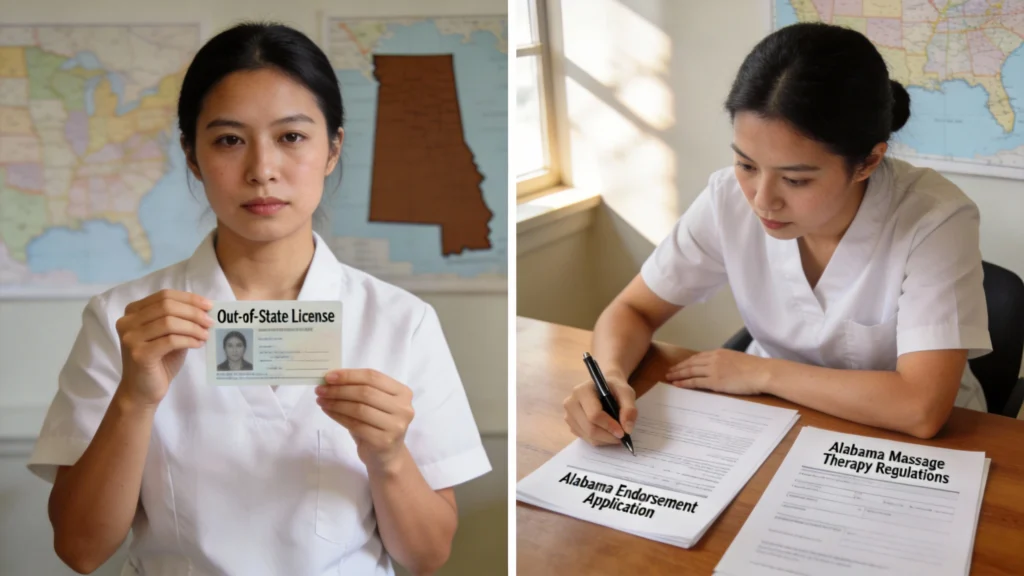
If you’re already licensed elsewhere, Alabama may allow you to apply by endorsement instead of starting from scratch. However, the board still checks your education, exam history, and disciplinary record. Reviewing Alabama’s specific rules for out-of-state applicants helps you understand what will transfer and what additional steps you might need.

Education, Exams, and Background Checks

Most applicants must complete a minimum number of clock hours in an approved massage program, commonly in the 500–650 hour range, including anatomy, physiology, ethics, and supervised clinic practice. The board then requires a passing score on a nationally recognized exam, usually the MBLEx, sent directly from the testing organization. A fingerprint-based background check, processed through state and federal databases, screens for disqualifying convictions.

Documentation, Fees, and Eligibility Details

Applicants typically submit transcripts, exam verification, proof of age (often 18 or older), and lawful presence or citizenship documentation. The Alabama massage therapy board charges nonrefundable application and initial license fees, often totaling a few hundred dollars. Because incomplete files delay review, many candidates request sealed transcripts, exam score transfers, and background check appointments several weeks before submitting their application package.

3

How to Apply to the Alabama Board of Massage Therapy Step by Step

How to Apply to the Alabama Board of Massage Therapy Step by Step

Applying to the Alabama Board of Massage Therapy is easier when you break it into clear steps. After finishing your approved program and exam, you’ll assemble verification documents, complete the board’s application, and pay required fees. Understanding this sequence ahead of time helps you avoid missing items that could delay your license.

Applying for an Alabama massage therapy license involves several coordinated steps with strict sequencing. You’ll usually start by confirming your school is board-approved, then schedule your MBLEx, and finally complete the state application. The Alabama massage therapy board offers both online and paper options, but online portals often process faster because documents and payments are logged immediately into the licensing system.

Application Timeline and Key Milestones

Planning your timeline helps avoid gaps between graduation and legal practice. Many students schedule the MBLEx within 30–60 days of finishing school so scores reach the board quickly. At the same time, they request official transcripts and initiate fingerprints. Once all third-party documents are in motion, they complete the state application, pay fees, and monitor their status using any available online license lookup or applicant tracking tools.

Typical Application Components and Costs

Most applicants submit a completed application form, fee payment, passport-style photo, transcripts, exam scores, and background check results. Some may also provide malpractice insurance proof or additional disclosures if they have prior disciplinary history. Because fees can include application, license issuance, and background check charges, budgeting $300–$500 is common. Keeping copies of every document and receipt simplifies follow-up if the board requests clarification.

4
alabama massage therapy board

Alabama Massage Therapy Board Rules for Out-of-State and Endorsement Applicants

Therapists already licensed elsewhere often seek Alabama licensure by endorsement instead of repeating full entry requirements. The Alabama massage therapy board compares your existing license, education hours, and exam scores against Alabama standards. If your original state’s requirements are substantially equivalent, the board may waive certain components, though you still must complete an Alabama application and pass background screening.

Alabama Massage Therapy Board Rules for Out-of-State and Endorsement Applicants

New applicants must meet specific Alabama licensing requirements, including approved education hours, passing a recognized exam, and completing background checks. Planning ahead with a clear checklist helps you gather transcripts, test scores, and other documents efficiently so your application can be processed smoothly by the Alabama Board of Massage Therapy.

Endorsement and Reciprocity Considerations

License by endorsement usually requires holding an active, unencumbered license in another state, often for a minimum continuous period such as one year. The board requests verification sent directly from your original state, detailing education, exams, and any disciplinary actions. If that state had lower hour requirements, Alabama may require supplemental coursework or proof of additional continuing education to close the gap before issuing a license.

  • Request official license verification from your current state board, including disciplinary history, sent directly to Alabama’s board office.
  • Compare your education hours to Alabama’s minimum; plan bridge courses if you completed fewer classroom or clinic hours.
  • Confirm your national exam (such as MBLEx) is recognized by Alabama before submitting endorsement paperwork or paying fees.
  • Prepare to document recent practice hours or employment history if the board evaluates competency based on active work experience.
  • Allow several weeks for interstate mail and processing, especially when multiple boards must exchange verifications and records.
5

Continuing Education and Renewal with the Alabama Board of Massage Therapy

Once licensed, you must renew regularly and complete continuing education (CE) to maintain active status. The Alabama Board of Massage Therapy sets renewal cycles, commonly every one or two years, with specific CE hour requirements that might range from 12–24 hours per cycle. Some hours must cover ethics or Alabama law, ensuring practitioners stay current on professional responsibilities and regulatory changes.

Continuing Education and Renewal with the Alabama Board of Massage Therapy

Renewal Cycles, CE Hours, and Approved Providers

Renewal notices are often emailed or mailed 30–60 days before expiration, but you remain responsible even if notices are missed. CE must typically come from board-approved or NCBTMB-approved providers, with limits on online versus in-person hours. Many therapists plan CE gradually, taking 4–6 hours every few months, which spreads costs and prevents last-minute course shortages near renewal deadlines.

RequirementTypical AmountTimingNotes
Renewal cycle1–2 yearsBy license expiration dateLate fees often apply after a fixed grace period
Total CE hours12–24 hoursEach renewal periodSome cycles require specific ethics or law content
Ethics/law CE2–4 hoursWithin total CE hoursMust address boundaries, consent, and Alabama regulations
Online CE limit50–75% of totalPer renewal cycleRemaining hours may need live or hands-on training
Renewal fee$100–$200Due with renewalSeparate from late fees or reactivation charges

Reporting CE usually involves attesting completion on the renewal form and retaining certificates for audit, often three to five years. The Alabama massage therapy board may randomly audit a percentage of licensees each cycle, requiring copies of certificates, course outlines, and provider approvals. Keeping a digital CE folder with scanned documents and course receipts makes responding to audits straightforward and reduces stress around renewal time.

6

Compliance, Complaints, and Disciplinary Actions Before the Alabama Massage Therapy Board

Compliance, Complaints, and Disciplinary Actions Before the Alabama Massage Therapy Board

The Alabama Board of Massage Therapy investigates complaints from clients, employers, or other agencies about potential violations. Allegations can involve boundary issues, unlicensed practice, fraudulent credentials, or failure to maintain sanitary conditions. When a complaint is filed, the board reviews records, interviews witnesses, and may request your written response. Outcomes range from dismissal to formal discipline recorded on your public license profile.

Common Violations and Investigation Process

Frequent violations include practicing with an expired license, misrepresenting credentials, or providing services outside the defined scope of massage therapy. Investigations often begin with a preliminary review to determine jurisdiction, followed by fact-gathering and possibly an informal conference. If evidence supports a violation, the board may negotiate a consent order or schedule a formal hearing, where testimony and documentation are presented under oath.

Disciplinary Sanctions and Long-Term Impact

Sanctions can include reprimands, fines, mandated ethics courses, probation, suspension, or revocation. Even minor discipline may appear in license lookup systems used by employers and other state boards.

The most serious long-term consequences often stem from failing to respond to board communications or concealing information, rather than from the underlying mistake itself.

Therapists who cooperate fully, correct deficiencies quickly, and demonstrate insight usually receive more limited, manageable sanctions.

7

Contacting the Alabama Board of Massage Therapy and Finding Official Resources

Because rules and fees change, you should always confirm details directly with the Alabama Board of Massage Therapy before acting on any guide. The board’s official website typically posts current application forms, fee schedules, CE policies, and disciplinary actions. It also lists phone numbers, mailing addresses, and email contacts for licensing, complaints, and general information, often separated by department.

Contacting the Alabama Board of Massage Therapy and Finding Official Resources

Using Official Websites, Forms, and Statutes

The board’s homepage usually links to online license lookup, downloadable PDF applications, and instructions for fingerprinting or background checks. You’ll also find links to Alabama statutes and administrative rules governing massage therapy, which explain the legal basis for every requirement. Bookmarking these pages lets you quickly verify changes in CE rules, renewal deadlines, or endorsement pathways without relying on outdated third-party summaries.

  • Search for the official state domain, typically ending in “.gov”, to avoid confusing the board site with private organizations.
  • Download application and renewal forms directly from the Alabama massage therapy board to ensure you use the latest version.
  • Use the online license lookup to verify your public record, confirming your name, status, and expiration date are accurate.
  • Review posted meeting minutes or newsletters, which often summarize recent rule changes and enforcement priorities.
  • Call or email the licensing department if your situation is unusual, such as prior discipline or foreign education credentials.

Keeping an open line of communication with the Alabama massage therapy board supports a stable, compliant career. When you proactively check official resources before enrolling in school, applying, or choosing CE courses, you reduce the risk of surprises that delay licensure or renewal. Over time, familiarity with the board’s website, forms, and rules becomes as essential as your hands-on skills in sustaining a successful massage practice.

Face, Neck, Head, Body, Back & Foot Massager
For a Relaxing & Relieving Lifestyle
14-day money back guarantee
Lowest Prices: 365 Days Discount
Safe & Secure online payment
Contact Us

Massagers Mart © 2025. All Rights Reserved

Massagers Mart
Logo
Compare items
  • Total (0)
Compare
0
Shopping cart