

Abbreviation for Physical Therapy: PT, DPT, and Documentation Shortcuts

Abbreviations in physical therapy notes can either streamline documentation or create confusion during audits, billing reviews, and legal disputes. When different clinicians use different shortcuts for the same service, denials and charting inconsistencies increase. Standardizing how you abbreviate physical therapy protects revenue, clarifies clinical reasoning, and supports compliant, defensible records across your entire team.

Many clinicians ask whether the correct abbreviation for physical therapy is PT, P.T., or something else entirely. In most healthcare organizations, PT is the accepted shorthand for both the discipline and the licensed physical therapist. However, payers, regulators, and accreditation bodies care far more about clarity and consistency than stylistic preference when reviewing physical therapy documentation.

Because physical therapy billing depends on matching services, credentials, and codes precisely, sloppy abbreviations can trigger claim delays or rejections. A note that simply says “cont PT” without context tells an auditor very little about what was delivered, who provided it, and whether it matched the CPT codes billed. Aligning abbreviations with payer expectations helps every visit translate into clean, payable claims.

Standardized abbreviations also support communication with referring physicians, surgeons, and case managers who may skim dozens of progress notes daily. When every therapist in your clinic uses the same shortcuts for tests, measures, and interventions, readers can quickly understand progress and medical necessity. This article walks through correct usage of PT, DPT, and related abbreviations, then offers a practical reference for daily charting.

1
abbreviation for physical therapy

What Is the Standard Abbreviation for Physical Therapy in Healthcare?

What Is the Standard Abbreviation for Physical Therapy in Healthcare?

In most healthcare organizations, PT is the standard abbreviation for both the discipline and the licensed physical therapist, but what matters most is clarity. Clearly writing “Physical Therapy (PT)” on first use in your notes helps ensure payers, auditors, and other providers understand exactly what services were delivered and by whom.

Across hospitals, outpatient clinics, and home health agencies, PT is the standard abbreviation for physical therapy as a profession and service line. You will see PT used in scheduling systems, referral orders, and departmental names such as “Outpatient PT.” In written physical therapy documentation, most organizations avoid periods, treating PT as a professional designation rather than a sentence abbreviation.

How PT Appears in Clinical Records

Within clinical notes, PT usually labels the service type, discipline, or department responsible for care. For example, an inpatient order might read “PT eval and treat, bid, start 1/15/2026.” Progress notes often include headings like “PT Assessment” or “PT Plan” to distinguish them from OT or SLP. Using PT consistently across templates ensures quick chart navigation for multidisciplinary teams.

PT in Scheduling and Operational Systems

Electronic medical record systems frequently categorize encounters under PT to drive reporting and billing workflows. A visit may be tagged as “PT visit, 45 minutes” with associated CPT codes such as 97110 or 97140. When PT is used uniformly in these systems, administrators can accurately track visit volumes, payer mix, and productivity, supporting data-driven decisions on staffing and service expansion.
2

Abbreviation for Physical Therapy vs. Physical Therapist: PT, DPT, and More

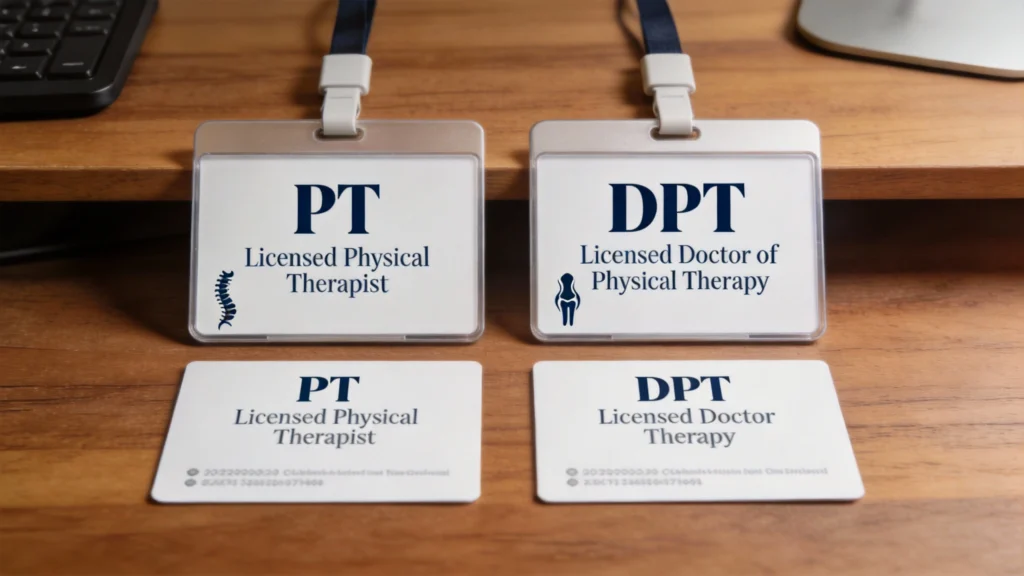
Confusion often arises because PT describes both the discipline and the licensed professional, while DPT is an academic degree. A physical therapist may hold a DPT (Doctor of Physical Therapy) but still sign as “PT” to indicate licensure. Understanding these distinctions helps prevent misrepresentation of qualifications in physical therapy documentation and external communications.

Abbreviation for Physical Therapy vs. Physical Therapist: PT, DPT, and More

In billing and insurance forms, the abbreviation PT must align with correct provider types, CPT codes, and payer-specific rules. When your documentation language matches what appears on claims, it reduces discrepancies that can trigger denials. Consistent abbreviations across notes, superbills, and claim forms support smoother reimbursement and fewer coding disputes.

Credentials Commonly Seen in PT Signatures

Clinicians typically list their highest clinical degree first, followed by licensure and then board certifications. For example, a therapist might sign “Jane Smith, DPT, PT, OCS” to reflect a doctoral degree, state licensure, and orthopaedic specialization. Support personnel use credentials such as PTA for physical therapist assistant or ATC for certified athletic trainer, clarifying scope and billing eligibility.

  • DPT indicates completion of a Doctor of Physical Therapy program, typically 3 years post-baccalaureate, not licensure itself.
  • PT identifies state-licensed physical therapists authorized for evaluation, plan development, and Medicare billing as qualified professionals.
  • PTA designates licensed physical therapist assistants who provide delegated interventions but cannot perform initial evaluations.
  • OCS, NCS, and SCS represent APTA-recognized specialty certifications requiring board exams and periodic recertification.
  • CSCS is a strength and conditioning credential often appended when therapists provide sports performance or return-to-play services.
3

Using the Abbreviation for Physical Therapy Correctly in Documentation

Using the Abbreviation for Physical Therapy Correctly in Documentation

Using the abbreviation for physical therapy correctly in documentation means pairing shorthand with context. Templates that define common PT abbreviations, require key fields, and guide clinical reasoning notes help therapists chart quickly without sacrificing clarity. This structure reduces misinterpretation during audits, peer review, and transitions of care between providers.

Correct use of PT within daily notes, evaluations, and discharge summaries focuses on clarity about who did what, when, and why. Abbreviations should never obscure clinical reasoning or medical necessity. Surveyed auditors frequently cite vague shorthand as a reason for downcoding visits, especially when intensity, assistance levels, or progression are not clearly documented.

Best Practices in Evaluation and Daily Notes

During initial evaluations, spell out “physical therapy evaluation” in the opening sentence, then transition to PT for brevity. For example, “Patient referred for physical therapy evaluation due to post-op knee pain; PT exam reveals limited ROM and weakness.” In daily notes, combine PT with specific tests and measures, such as “PT session emphasized quad strengthening, 3 sets of 10 reps, 5 lb resistance.”

Clear Documentation in Progress and Discharge Summaries

In progress and discharge summaries, use PT alongside objective change to support continued care or safe discharge. A statement like “Since starting PT, knee flexion improved from 90° to 120°, and gait speed increased from 0.6 m/s to 0.95 m/s” ties interventions to measurable outcomes. This level of detail reassures payers that physical therapy services were skilled and medically necessary.

4

The Abbreviation for Physical Therapy in Billing, Coding, and Insurance Forms

In the billing environment, PT identifies the discipline responsible for CPT codes and modifiers on claim forms. Clearinghouses and payers rely on provider taxonomy codes and discipline flags to determine coverage rules, visit limits, and authorization requirements. When PT is misclassified or omitted, claims may deny as non-covered services despite accurate clinical work.

The Abbreviation for Physical Therapy in Billing, Coding, and Insurance Forms

Clinicians often wonder whether to use PT or DPT after their names. PT typically refers to the role or license, while DPT refers to the earned doctoral degree. Using credentials in a consistent order on signatures, business cards, and documentation helps distinguish professional title, license, and academic preparation clearly.

How PT Appears on Common Insurance Forms

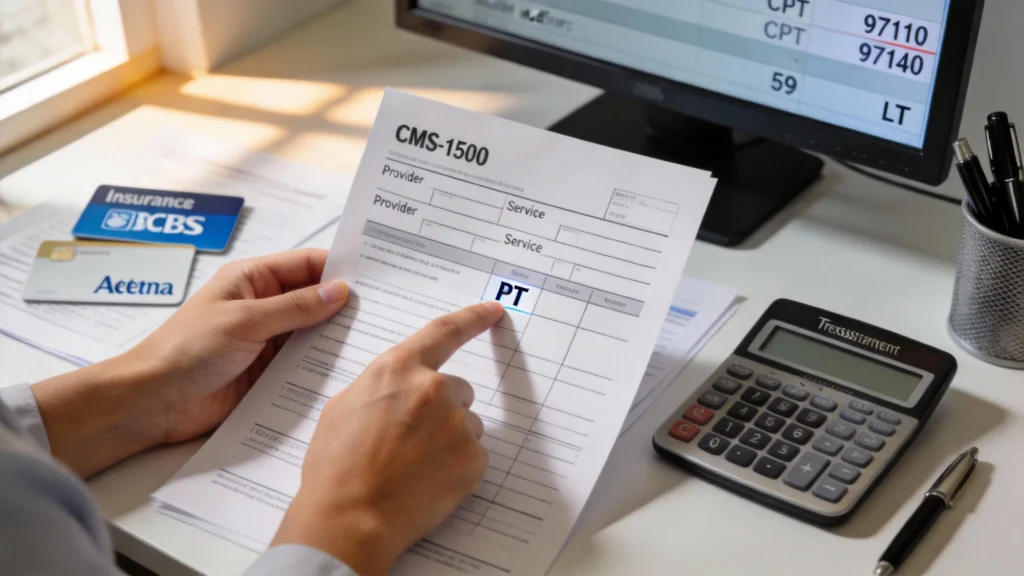
On the CMS-1500 claim form, PT services typically fall under provider taxonomy code 225100000X for physical therapists. Many practice management systems label charge tickets with “PT” to separate them from occupational therapy or speech-language pathology charges. Some insurers, like Aetna and UnitedHealthcare, publish policies specifically titled “Physical Therapy (PT) and Occupational Therapy (OT) Services,” reinforcing PT as the standard abbreviation.

When physical therapy billing aligns PT abbreviations, CPT codes, and documentation details, denial rates often drop by 10–20%, according to internal audits from multi-site outpatient networks. Consistency helps billing staff quickly match charted minutes and interventions to the correct timed and untimed codes, reducing rework and appeals workload across the revenue cycle team.

5

Common PT Documentation Abbreviations and Their Meanings

Because PT sessions involve multiple tests, measures, and interventions within 30–60 minutes, abbreviations save time without sacrificing clarity. However, overusing obscure shortcuts can confuse covering therapists and external reviewers. Creating a shared glossary of PT abbreviations helps new staff quickly learn your documentation style while keeping notes concise, readable, and audit-ready.

Common PT Documentation Abbreviations and Their Meanings

Reference Table of Frequently Used PT Abbreviations

The following table summarizes common PT documentation shortcuts for assessments and interventions, along with typical usage examples. Values such as degrees, repetitions, and gait distances reflect real clinical ranges seen in orthopedic and neurologic outpatient practice. Adopting similar standards across your EMR templates can significantly streamline chart review and interdisciplinary communication.

AbbreviationMeaningTypical Measurement/RangeExample in Note
AROMActive Range of Motion0–150° shoulder flexion, 0–135° knee flexionAROM knee flex 0–120°, limited by pain at end range
MMTManual Muscle TestingGrade 0–5 using standard scaleMMT quad 4/5 bilaterally, mild fatigue after 10 reps
GTGait TrainingDistances 25–300 ft, various assist levelsGT 150 ft with RW, CGA, 2 standing rests required
HEPHome Exercise Program3–6 exercises, 10–15 reps eachHEP issued: bridges, clamshells, SLR, 2x/day, 10 reps
ROMRange of MotionJoint-specific degrees documented by goniometerROM shoulder abd 0–160°, compared with 0–180° contralateral
NPVNext PT VisitScheduled within 2–7 daysNPV: progress balance training, add uneven surfaces

Integrating this type of table into onboarding materials helps standardize how therapists abbreviate common elements of physical therapy documentation. When everyone records AROM, MMT, GT, and ROM in the same way, supervisors can quickly compare outcomes across patients and clinicians. This consistency also strengthens your defense during payer audits, because reviewers immediately understand each shorthand without needing clarifying addenda.

7

Standardizing the Abbreviation for Physical Therapy Across Your Clinic

Standardization starts with deciding which abbreviations your clinic will allow, then embedding those choices into templates, smart phrases, and staff training. A short style guide that defines PT, DPT, PTA, and common documentation shortcuts prevents each therapist from inventing personal systems. This consistency directly supports accurate physical therapy billing and cleaner audit trails.

Standardizing the Abbreviation for Physical Therapy Across Your Clinic

Creating a PT Abbreviation Style Guide

Develop a two-page reference listing approved abbreviations, disallowed shorthand, and examples of compliant note phrasing. For instance, permit AROM, PROM, and MMT, but prohibit nonstandard shortcuts like “str” for strengthening. Review the guide annually with your compliance or billing team to align with payer feedback. Posting it in workrooms encourages quick consultation during busy documentation periods.

  • Include a table of approved PT abbreviations, with meanings and sample usage sentences pulled from real notes.
  • Highlight high-risk phrases flagged by auditors, replacing them with clearer alternatives that specify intensity and assistance.
  • Train new hires using mock charts, requiring them to interpret and write notes using the standardized abbreviation set.
  • Coordinate with coders so physical therapy documentation abbreviations match charge capture workflows and modifier usage.

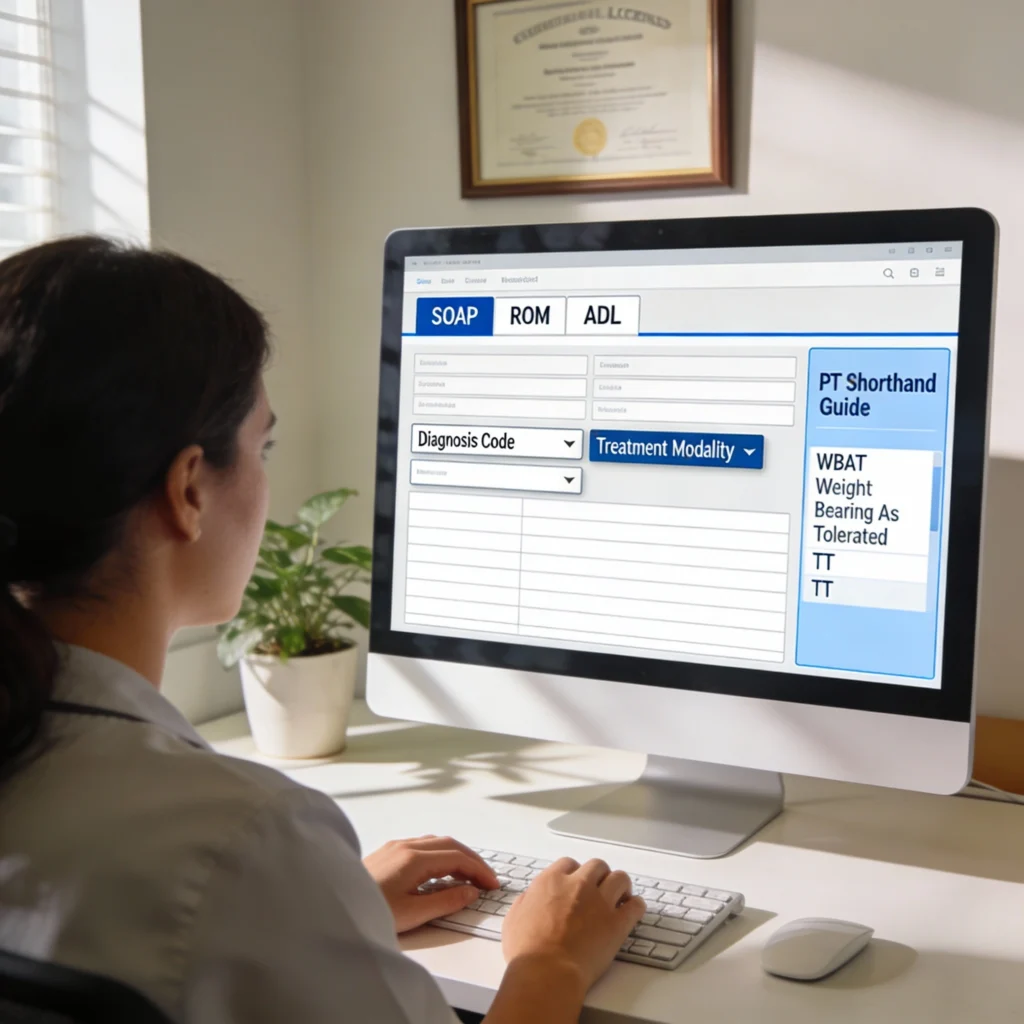
Once your style guide is finalized, work with your EMR vendor or internal IT team to update templates, smart texts, and quick-pick lists. Embedding PT, PTA, and common test abbreviations directly into dropdown fields reduces free-text variability. Over time, regular chart audits can confirm that therapists follow the standard, improving both clinical communication and reimbursement reliability.

Face, Neck, Head, Body, Back & Foot Massager
For a Relaxing & Relieving Lifestyle
14-day money back guarantee
Lowest Prices: 365 Days Discount
Safe & Secure online payment
Contact Us

Massagers Mart © 2025. All Rights Reserved

Massagers Mart
Logo
Compare items
  • Total (0)
Compare
0
Shopping cart